Living Abroad: Which Countries Offer Financial Benefits in Retirement?

More sunshine, lower cost of living, and a daily life that better suits their retirement: For many people, living abroad in retirement is an attractive prospect. Some countries also entice retirees from abroad with special tax regulations. However, moving abroad is not automatically financially beneficial. In addition to rent, food, and taxes, health insurance, care, exchange rates, right of residence, and distance from family also play a role. A country with low prices can become expensive if private medical services, regular flights to Germany, or additional international health insurance are required. In this article, you will learn about the financial advantages of living abroad in old age, which countries offer special tax regulations, and what you should check before moving.
Key facts at a glance
- German pensions can generally also be paid abroad.
- Within the EU, the European Economic Area, and Switzerland, many processes are simpler than in other countries.
- Greece, Italy, and Cyprus offer special tax regulations for foreign pension income under certain conditions.
- Tax advantages alone are not sufficient for choosing a country.
- Health insurance, medical care, and potential long-term care costs should be clarified early on.
- The tax treatment depends on the place of residence, the type of pension, and the respective double taxation agreement.
What financial benefits does living abroad offer in old age?
Retiring abroad can be financially attractive, especially if the running costs in the destination country are lower than in Germany. Depending on the region, this particularly applies to:
- Rent and property prices,
- Groceries and restaurant visits,
- Public transport,
- Household-related services,
- Leisure activities,
- Outpatient support and care.
This means that a consistent pension can offer more opportunities in everyday life. The differences can be particularly large between German cities and smaller towns in Southern or Southeastern Europe. Some states also offer special tax regulations for people who transfer their tax residence and receive a pension from abroad. However, these models are subject to conditions and do not automatically apply to every German pension.
Safety abroad too

Is the German pension also paid out abroad?
The German statutory pension can, in principle, also be paid abroad. In the case of a permanent move within the EU, the European Economic Area, or to Switzerland, it will generally continue to be paid in full. For other countries, restrictions may apply depending on the type of pension and social security agreements. Inform the German Pension Insurance (Deutsche Rentenversicherung) of your move and your new address in good time. Depending on the country of residence, a certificate of life may also be required regularly.
Which countries offer tax advantages to retirees?
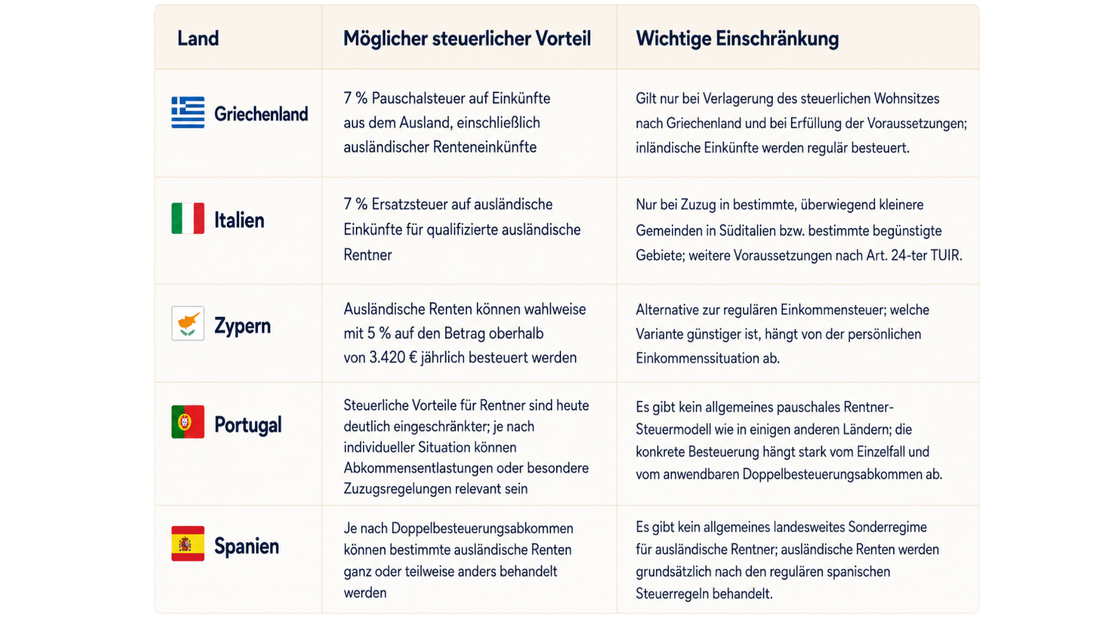
Some European countries offer special tax regulations for people who relocate in retirement. Other countries are particularly attractive due to lower housing and living costs.
Frequently mentioned destinations include:
- Greece,
- Italy,
- Cyprus,
- Bulgaria,
- Spain,
- Portugal.
However, the advantages differ significantly. While some countries advertise fixed tax rates on foreign income, the financial benefits elsewhere arise more from lower rents, services, and daily costs. The overall personal calculation is always important. A tax benefit can be offset by high housing costs, private healthcare services, or regular trips to Germany.

Greece: Special Taxation for Foreign Pensioners
Greece offers individuals with foreign pensions the opportunity to transfer their tax residence to the country and apply for special taxation of foreign income. The model provides for a flat tax rate of seven percent and can apply for up to 15 tax years under certain conditions. One prerequisite is that the person concerned has not been tax resident in Greece for several years prior. In addition, living and housing costs outside particularly popular islands and coastal regions can be lower than in major German cities.
Potential Benefits in Greece
- seven percent on certain foreign income,
- often lower housing costs outside tourist centers,
- everyday life in the Eurozone,
- EU membership,
- comparatively inexpensive services.
The regulation must be applied for. Before moving, it should also be checked which pension components and other income are actually covered.
Italy: Seven percent rule in selected municipalities

Italy offers certain foreign retirees a special seven percent taxation on their foreign income. However, the regulation does not apply nationwide. The new residence must generally be located in a qualified smaller municipality in specific regions of Southern Italy. Large cities and many well-known holiday regions are not included.
Potential Benefits in Italy
- seven percent on certain foreign income,
- sometimes affordable properties in smaller municipalities,
- life within the EU and the Eurozone,
- good accessibility from Germany,
- a wide selection of different regions.
This model is particularly suitable for people who deliberately want to live in a smaller municipality. Those who prefer Rome, Milan, Tuscany, or particularly popular coastal towns usually cannot take advantage of the special regulation.
Bulgaria: Low cost of living

Bulgaria does not offer a special tax rate that automatically applies to every foreign pension. The main financial advantage lies in the often lower housing and living costs. Outside of the large cities and tourist regions, rents, services, and sometimes even real estate are significantly cheaper than in Germany.
Potential Advantages in Bulgaria
- often low rents,
- cheaper food and services,
- comparatively low running costs,
- EU membership,
- sometimes affordable real estate.
These advantages are offset by regional differences in medical care, infrastructure, and language barriers. The tax treatment of German pensions must also be individually reviewed.
Cyprus: Five Percent Tax on Foreign Pension Income

Cyprus offers a special taxation option for foreign pensions. Pension income above an allowance of 3,420 euros can be taxed at five percent. Alternatively, the regular income tax can be chosen. This can make Cyprus attractive from a tax perspective. At the same time, living costs vary significantly depending on the region.
Possible advantages in Cyprus
- five percent on foreign pensions above the allowance,
- EU membership,
- payments and daily life in euros,
- mild climate,
- moderate daily costs depending on the region.
However, in popular coastal towns, rents and property prices can be significantly higher. Therefore, the specific place of residence should always be considered before moving.
Spain and Portugal: Popular, but Not Automatically Tax-Friendly

Spain and Portugal are among the most popular retirement destinations due to their climate, coastal regions, and existing German-speaking communities. Smaller towns and regions away from the well-known tourist centers are particularly attractive financially. In popular coastal regions, on islands, or in large cities, however, rents and property prices can be high.
Potential advantages
- Lower daily living costs, depending on the region,
- Wide choice of places to live,
- Good flight connections to Germany,
- EU membership and the Euro,
- Good infrastructure in many places.
Portugal was long considered particularly tax-friendly. However, caution is advised with older information on the internet, as regulations can be changed or discontinued for new applicants.
In which countries can the Gardia emergency wristband be used?
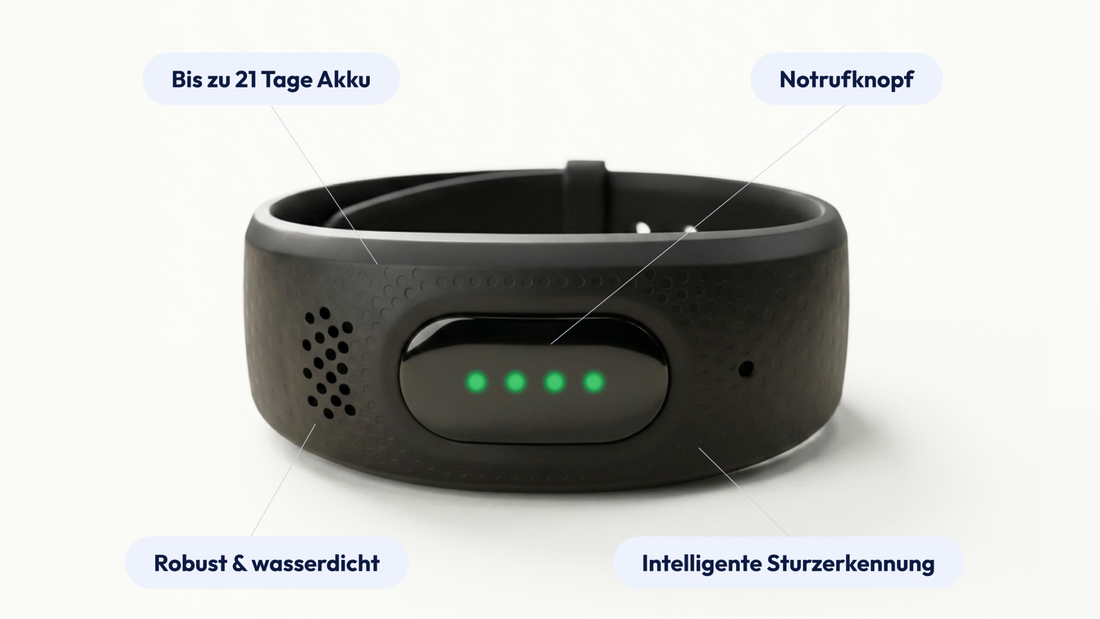
Bosch's professional 24/7 emergency call center can currently be used in the following countries: Austria, Belgium, Bulgaria, France, Germany, Hungary, Ireland, Italy, Liechtenstein, Luxembourg, Malta, Netherlands, Poland, Portugal, Romania, Spain, and United Kingdom. In these countries, both emergency calls to private emergency contacts and to the professional Bosch 24/7 emergency call center are possible.
Can the Gardia emergency bracelet be used in Switzerland?
The Gardia emergency bracelet cannot currently be used in Switzerland, as the 2G mobile network has already been switched off there. Before moving or staying for an extended period, please check whether your destination country is supported and which emergency options are available there.
Where do you have to pay tax on your pension?
Whether your pension is taxed in Germany or in your new country of residence depends on your tax residence, the type of pension, and the respective double taxation agreement. Statutory pensions, civil servant pensions, company pensions, and private pensions may be treated differently. Other income from real estate or capital investments can also change your tax situation.
Therefore, before moving, you should check:
- which country is allowed to tax your income,
- whether you remain taxable in Germany,
- whether a tax declaration is required in the destination country,
- whether the respective special regulation actually applies to you.
Health Insurance and Stays in Other EU Countries
When permanently relocating within the EU, German statutory health insurance can, under certain conditions, remain responsible for your coverage. The S1 form is often required for this, which is registered in the new country of residence. You then gain access to medical care according to the rules of that country.
However, the level of benefits, waiting times, and potential out-of-pocket expenses may differ from those in Germany.
In particular, check:
- the distance to doctors and hospitals,
- the availability of regularly needed medications,
- out-of-pocket expenses and co-payments,
- the possibility of private supplementary insurance.
For stays longer than three months, registration in the destination country may also be required. Retirees often have to prove sufficient financial resources and health insurance coverage.
Staying connected, even from afar

What additional costs are often underestimated?
Low rents do not automatically mean that all daily life becomes cheaper. Often underestimated are:
- regular trips to Germany,
- additional health insurance,
- private medical services,
- tax consultancy in two countries,
- translations and official procedures,
- exchange rate losses outside the Eurozone,
- future care and support costs.
Therefore, consider not only the monthly expenses at your place of residence, but also all costs arising from the distance to Germany.

Checklist: Is living abroad financially worthwhile?

- What are the rent and utility costs at the specific place of residence?
- How are my individual pension incomes taxed?
- Does a special tax regulation actually apply to me?
- Do I remain liable for tax in Germany?
- How am I covered by health and long-term care insurance?
- What co-payments arise for medical services?
- Do I need additional international health insurance?
- How expensive are regular trips to Germany?
- Are there exchange rate risks?
- What residency and reporting obligations apply?
- Is there good medical care nearby?
- How can I quickly get help in an emergency?
- Have I already tested the country outside of the holiday season?
Conclusion
Living abroad in retirement can offer financial advantages. Lower rents, cheaper services, and reduced daily expenses can increase the purchasing power of your pension. Greece, Italy, and Cyprus also offer special tax regulations for people with foreign pension incomes. However, these only apply under certain conditions. Whether the move is truly worthwhile can only be determined by a personal overall calculation. In addition to taxes and living costs, this includes health insurance, medical care, travel to Germany, potential nursing care costs, and safeguarding in emergencies. Within the EU, pension payments, right of residence, and health insurance are often easier to organize than when moving to a third country. Nevertheless, every decision should be individually reviewed. The German Pension Insurance (Deutsche Rentenversicherung), the health insurance company, and a tax consultancy specializing in cross-border matters should therefore be involved at an early stage.
FAQ: Frequently Asked Questions
Which country is particularly tax-favorable for German pensioners?
Can I receive my full German pension abroad?
Do I have to pay taxes on my German pension abroad?
Do I remain health insured when staying abroad in an EU country?
Can I use Gardia abroad?
"When my daughter moved abroad with her family, the decision wasn't easy for me at first. At some point, I realized that as I got older, I'd rather be closer to her than stay alone in Germany. The move not only gave me more time with my family, but also the reassuring feeling of having support nearby in everyday life. With Gardia, I can still remain independent and quickly get help in an emergency."