Fall Risk in Old Age: Why Women Are More Affected

Falls are not a peripheral issue in old age. They are among the most common health risks overall. Approximately one in three people over 65 falls at least once a year. From the age of 80, the risk increases significantly further.
Women are particularly affected. They not only fall more often but also carry a higher risk for severe consequences such as hip fractures or vertebral fractures. However, this is not simply due to age. It is the interaction of several factors.
Fall Risk in Old Age: How Common Are Falls Really?
Studies show: Around 30% of people over 65 fall at least once a year. Among the very elderly, it's almost every second person.
Many falls do not result in serious injury – and are therefore often not documented. The actual extent is therefore likely to be higher.
The risk increases with:
- decreasing muscle strength
- impaired balance
- slowed reaction
- multiple medications
- changes in vision or hearing
A fall already experienced also significantly increases the likelihood of another. Falls are therefore not coincidental, but a typical age-related risk that should be taken seriously.
Why Women Are Particularly Vulnerable
After menopause, estrogen levels drop significantly. This hormone plays a central role in maintaining bone mass.
With the hormonal decline, natural bone loss accelerates. The consequences can be:
- reduced bone density,
- increased bone fragility,
- and thus a significantly higher risk of fractures.
The hips and spine are particularly often affected – injuries that can have serious effects on mobility and independence in old age.
Security that thinks along
So that immediate action is taken in an emergency. At the touch of a button or automatically by an integrated fall detection system. This immediately triggers an alarm, informs contacts, and help can be organized without losing valuable time.

2. Muscle Strength and Stability
On average, women have less muscle mass than men. If muscle loss also occurs with age, this has a more noticeable impact on balance and responsiveness. When stumbling, fractions of a second decide whether one can catch oneself.
Less muscle strength means:
- reduced stability
- slower corrective movements
- unsteadier gait
3. Psychological Factors and Self-Confidence
In addition to physical causes, psychological factors also play a role. A large British long-term study with several thousand older participants showed that people with higher self-esteem had a significantly lower risk of falling.
The explanation is obvious: those who feel secure move more upright and stable. Older women, in particular, often suffer from a fear of falling or withdraw more after an initial incident. However, less movement leads to further muscle loss – creating a vicious circle.
4. Biomechanical Differences
Anatomical differences also play an important role. On average, women have physical characteristics that can influence the risk of falling:
- a different pelvic structure,
- an altered leg axis,
- as well as a slightly adapted gait as a result.
These factors are usually unproblematic at a younger age. However, with increasing age, when muscle strength, coordination, and reaction speed can decrease, they can more strongly affect balance. Fall prevention therefore means not only building muscle, but also a conscious, stable movement pattern in everyday life.
Recognizing warning signs early
Falls often announce themselves.
Typical signs include:
- unsteady or shuffling gait
- frequently holding onto furniture
- difficulty getting up
- dizziness
- avoiding stairs
Such signs should be taken seriously – especially with existing osteoporosis or previous falls.
Why Women Fall Differently
In addition to hormonal and muscular factors, biomechanical differences also play a role.
On average, women have:
- a wider pelvic structure
- an altered leg alignment
- a shorter stride length
- a different shift in their center of gravity
These anatomical peculiarities influence gait. In old age, when muscle strength and reaction time decrease, balance can be destabilized more quickly.
It is also striking that many women react to insecurity with smaller, more cautious steps. While this feels safe, it can paradoxically reduce stability. This is precisely why it is important to approach fall prevention individually, with training, awareness work, and, if necessary, additional support in the background.
Security Boosts Confidence
An often underestimated factor in the risk of falling is the feeling of safety in everyday life. Those who fear a possible fall often move more cautiously, avoid certain paths, or withdraw. Here, an emergency call bracelet can foster greater self-confidence.
Knowing that one is not alone in an emergency often reduces inner tension. Many users report that with a backup system in place, they feel freer to move around – at home, on walks, or out and about.
A mobile emergency call system can:
- organize quick help
- shorten response time in an emergency
- prevent prolonged lying after a fall
- automatically inform relatives or a professional 24/7 emergency call center
Especially prompt care after a fall can reduce subsequent damage and prevent complications.

The Gardia emergency wristband combines this quick assistance with a simple, wearable solution for at home and on the go. It does not replace prevention – but it can be an important safety net that supports independence instead of restricting it.
What are the consequences of falls?
A fall in old age is rarely harmless.
In addition to bruises and fractures, there is a risk of:
- long hospital stays
- permanent mobility impairments
- loss of independence
Then there is the psychological component. Many affected individuals develop a pronounced fear of falling again after a fall. This fear often leads to less movement – and thus to even more instability.

Prevention Specifically for Women
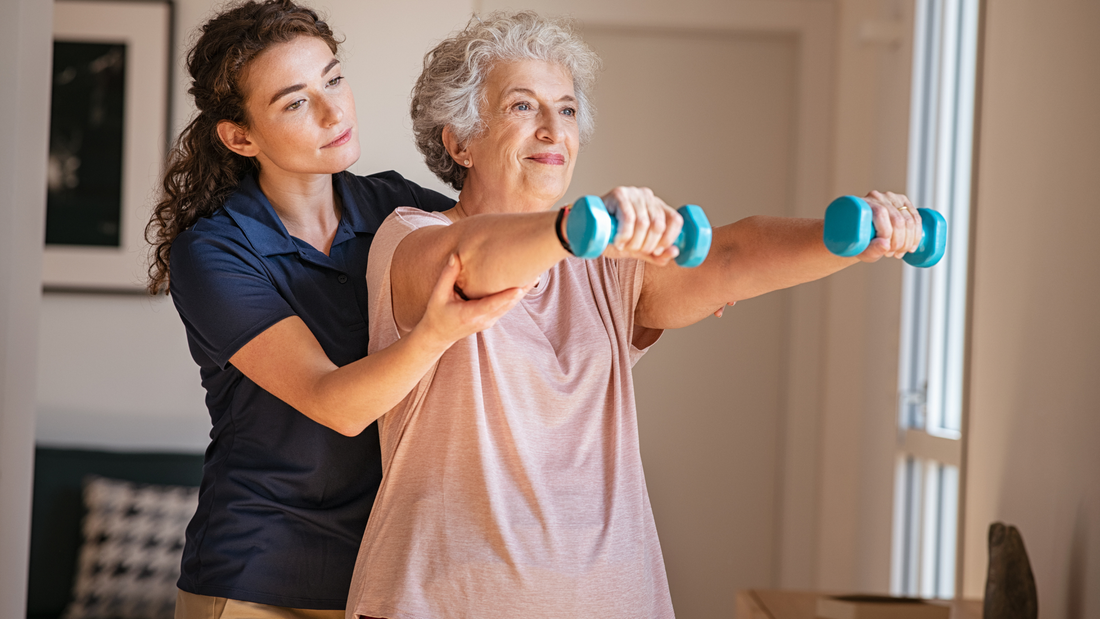
1. Build Muscle Strength Systematically
Strength and balance training are among the most effective measures. Even moderate training can make a big difference.
Regular exercises improve posture, increase responsiveness, and stabilize gait. This is especially important for women, as muscle loss becomes more significant with age.
Just two to three training sessions per week can measurably reduce the risk of falling.
2. Actively Support Bone Health
After menopause, bone health becomes a particular focus.
Important components include:
- adequate vitamin D supply
- protein-rich diet
- medical clarification if osteoporosis is suspected
The stronger the bones, the lower the risk of severe fractures in the event of a fall.
3. Strengthen Self-Esteem and Security
Fall prevention is not just physical.
Studies show that psychological well-being has a direct impact on physical stability. Those who feel secure move more confidently and stably.
Therefore, these points are also crucial:
- promote independence
- maintain social contacts
- enable positive movement experiences
Especially after a fall, it is important not to fall into avoidance behavior.
4. Design a Safe Home Environment
Many falls happen in one's own home.
Even small adjustments can make a big difference:
- non-slip mats
- grab bars in the bathroom
- good lighting
- stable handrails
This is not about restriction, but about safety in everyday life.
5. Technical Solutions as a Supplementary Safety Net
Despite all prevention, falls can never be completely ruled out.
Here, technical solutions can be a useful supplement.
A mobile emergency call system ensures that help is quickly organized in an emergency - even if no one is directly on site.
The Gardia emergency call wristband, for example, enables:
- quick alarming at the touch of a button
- automatic fall detection
- notification of emergency contacts
- help even outside one's own home
Important: Technology does not replace prevention. It complements it.
Conclusion
Falls in old age are rarely an isolated event – they are usually the result of many small factors that develop over years. Especially in women, hormonal changes, decreasing muscle strength, altered bone density, and often insecurity in everyday life come together. What initially seems harmless can suddenly have far-reaching consequences – both physically and emotionally. At the same time, it shows: prevention works. Those who specifically strengthen their mobility and strength, undergo regular check-ups, reduce tripping hazards, and take warning signs seriously can significantly lower the risk. It's not about instilling fear – but creating awareness.
Because ultimately, it's not statistics that are at the forefront, but quality of life. Mobility means independence, participation, and freedom. And it is precisely these that need to be protected – with knowledge, attention, and the right structures in everyday life.
FAQ/Frequently Asked Questions
Are women really more affected by falls than men?
Yes. Studies show that older women fall more frequently and are significantly more likely to suffer serious injuries such as hip fractures. The main causes are osteoporosis, muscle loss, and hormonal changes.
Why does the psyche play a role in the risk of falling?
Psychological factors such as fear of falling or low self-esteem influence posture and gait. According to the ELSA study, individuals with higher self-esteem had up to a 19% lower risk of falling.
Can the risk of falling be actively reduced?
Yes. Strength and balance training, adequate protein and vitamin D intake, regular exercise, and adapting the home environment are particularly effective.
Why are hip fractures more common in women?
Women are significantly more affected by osteoporosis. This makes bone tissue more brittle – falls more quickly lead to fractures.
Does an emergency call system really help with the fear of falling?
An emergency call system does not prevent falls. However, it can provide a sense of security in the background. This feeling of security can help reduce fear of movement and maintain independence.
"I always thought falls only happened to other people. After my first fall, everything suddenly changed. I walked slower, held onto things, even in my own living room. The fear was worse than the fall itself. It wasn't until I regained confidence in my body - and had a safety net in the background - that I realized how important this feeling of security is. It gives me back the freedom to move normally again."