Emergency bracelet for seniors with early-stage dementia: When is it useful?

The front door key is suddenly in the refrigerator, a familiar path feels unfamiliar, or a phone number cannot be recalled at the crucial moment. Such situations can cause uncertainty – both for the person affected and their relatives. Not every instance of forgetfulness automatically means dementia. However, if memory, orientation, or daily routines become increasingly difficult, the cause should be medically clarified. Especially in the early stages of dementia, many people remain independent, do their shopping, go for walks, or spend time alone at home.
At the same time, the concern about what happens in the event of a fall, sudden weakness, or other emergency often grows. An emergency call bracelet for seniors can provide additional security during this phase. It is worn directly on the wrist and allows help to be requested with a central button. Models with automatic fall detection can also react to a possible fall if an active button press is no longer possible. However, whether an emergency call bracelet makes sense in early dementia always depends on the personal situation. Crucially, among other things, whether the affected person understands, accepts, and regularly wears the device.
In this article, you will learn when an emergency call bracelet for seniors can be helpful in early dementia, which functions are important, and where the limits of such a system lie.
What does early-stage dementia mean?
Dementia usually develops gradually. For this reason, changes are not always immediately noticeable at the beginning. Some people more frequently forget appointments or names. Others need more time to make decisions, lose their train of thought when telling a story, or have more difficulty orienting themselves in unfamiliar situations. In Alzheimer's dementia, memory, linguistic abilities, and orientation, among other things, decline over time. As a result, it becomes more difficult to cope with everyday life completely independently over time.
Possible early signs can be:
- frequently misplacing important items,
- repeatedly asking the same questions,
- difficulty with familiar tasks,
- uncertainty about the date or time,
- problems on less familiar routes,
- word-finding difficulties,
- decreasing concentration,
- difficulties with planning and organizing,
- changes in behavior or mood.
Individual observations of these do not yet prove dementia. Stress, depression, lack of sleep, certain medications, or physical illnesses can also affect cognitive performance. A reliable classification is therefore only possible through a medical examination
Why can everyday life become more unsafe with incipient dementia?
Many people with early-stage dementia continue to live actively and independently. The familiar home, established routines, and known paths provide orientation and security. The German Alzheimer's Association emphasizes that recurring routines and fixed places for important items can help maintain independence in daily life for as long as possible. Nevertheless, new uncertainties can arise.
Telephone numbers or routines are forgotten
In an emergency, it may be difficult to remember a phone number, unlock a smartphone, or select the right person. Even familiar operating steps can suddenly seem complicated under stress. A central emergency call button is usually easier to grasp than a smartphone with multiple menus and functions.
Dangers are recognized later
A hot stove, an open front door, or an obstacle on the floor may not be noticed immediately. Assessing a situation can also become more difficult.
Orientation declines
Some affected individuals may suddenly no longer find a familiar path or cannot accurately describe their current location. Orientation problems can be more noticeable, especially in unfamiliar surroundings.
The risk of falling can increase
Uncertainty when walking, distraction, unsuitable shoes, medication, or additional physical illnesses can increase the risk of a fall. An emergency call system with fall detection can provide additional security in such a situation.
When can an emergency wristband for seniors be useful in the early stages of dementia?
An emergency call wristband can be particularly helpful if the person concerned still lives largely independently and understands the simple meaning of the device.
This may be the case, for example, if the person:
- is regularly alone at home,
- goes for walks or shopping independently,
- has already fallen,
- suffers from dizziness or gait instability,
- cannot safely operate a smartphone in an emergency,
- frequently forgets important phone numbers,
- is more insecure after an operation or hospital stay,
- has relatives who do not live in the immediate vicinity,
- desires a simple sense of security on their wrist.
It is important not to focus solely on the diagnosis. Two people with the same diagnosis can have very different abilities and needs in everyday life. An emergency call wristband is useful if it suits the specific living situation and can actually be used.
Security in familiar daily life

Ease of use is particularly important
For individuals with early-stage dementia, an emergency call system should not be a distraction with numerous displays, apps, or complicated menus.
A well-suited emergency call wristband should:
- have an emergency button that is clearly palpable,
- function with a few simple steps,
- not require complicated daily operation,
- provide understandable acoustic feedback,
- sit comfortably on the wrist,
- need to be charged as infrequently as possible,
- function even without the wearer's smartphone.
Operation should be tried out together. This quickly reveals whether the affected person can find the button and understands what happens after pressing it.
Why a smartphone isn't always enough
Many relatives initially assume that a smartphone is sufficient for emergencies. After all, it has a phone function and is often nearby.
However, in crucial moments, it can be:
- in another room,
- connected to the charger,
- in a bag,
- switched off or discharged,
- locked with a code,
- confusing due to numerous icons.
After a fall or in cases of severe disorientation, the correct app must also be opened and a contact selected. A senior emergency wristband, on the other hand, remains directly on the wrist. A clearly visible or tactile button can therefore be more easily accessible.
How does an emergency alert bracelet for seniors work?
The exact process depends on the specific system. Generally, the emergency process starts with the push of a button or – for appropriately equipped models – after a detected possible fall.
The emergency call is triggered
The wearer presses the central emergency call button. For a device with automatic fall detection, the process can additionally begin if the system registers a possible fall.
The designated contacts are informed
Depending on the plan, private emergency contacts or a professional emergency call center are notified.
A voice connection is established
If the wristband has a loudspeaker and a microphone, communication can take place directly through the device. The affected person does not have to search for or hold a telephone.
The situation is assessed
The contacts can, for example, clarify:
- Is the person responsive?
- Are they in pain?
- Can they get up independently?
- Are they at home or out and about?
- Is a relative or medical help needed?
Help is organized
Depending on the situation, a relative can come by, a neighbor can be informed, or emergency services can be notified.

Automatic fall detection as an additional safeguard
In the early stages of dementia, it can happen that an affected person, after a fall, no longer remembers to press the emergency call button. Perhaps they are injured, confused, or temporarily unconscious. The Gardia Emergency Bracelet therefore features intelligent FallGuard360° fall detection. It evaluates various movements and changes in position. If the system detects a potential fall, the emergency process can begin even if an active button press is no longer possible. Before forwarding the alert, the Gardia Emergency Bracelet notifies the wearer that the process has been initiated. If no help is needed, the wearer can cancel the false alarm within the designated cancellation phase.
When is a medical alert bracelet not enough?
An emergency call bracelet can only help if the affected person wears it, accepts it, and the emergency process is suitable for their life situation.
As dementia progresses, it can become more difficult to:
- understand the meaning of the button,
- regularly put on the bracelet,
- cancel a false alarm,
- respond to a voice from the speaker,
- not remove the device independently,
- describe the situation to emergency contacts.
Even an automatic fall detection system does not replace care. It does not detect disorientation or every medical emergency.
An emergency call bracelet may therefore not be sufficient if the affected person:
- frequently leaves the home and cannot find their way back,
- can no longer assess acute dangers,
- regularly takes off the bracelet,
- no longer understands how to operate it,
- needs support around the clock,
- can no longer be left alone for extended periods.
In such cases, relatives should consult with medical, nursing, or advisory professionals to determine what additional help is necessary.

The Gardia Emergency Bracelet for Early Dementia
The Gardia emergency wristband consciously focuses on the emergency call function. It has a central emergency button and does not require the wearer to have a smartphone. It also features intelligent FallGuard360° fall detection. This evaluates various movements and changes in position. If the system detects a possible fall, the emergency process can begin even if an active button press is no longer possible.
Before forwarding, the Gardia emergency wristband alerts the user to the initiated process. If no help is needed, a false alarm can be terminated within the designated cancellation phase.
The most important functions include:
- central emergency button,
- FallGuard360° fall detection,
- integrated mobile connection,
- use without the wearer's smartphone,
- voice connection directly via the wristband,
- location transmission in an active emergency,
- private emergency contacts,
- optional professional 24/7 emergency call center from Bosch,
- up to 21 days of battery life.
Through the My Gardia App, the stored emergency contacts receive a notification in an emergency. In an active emergency, they can view the transmitted location and organize appropriate help. Depending on the chosen tariff, private contacts, the professional Bosch emergency call center, or both can be integrated into the emergency chain.
Quick information in an emergency

Connecting security and self-determination
Technical support should not unnecessarily restrict people with dementia. Used correctly, technical aids can help maintain independence for longer while improving safety.
This also means that an emergency call bracelet should not be used secretly or against the express wishes of the person concerned.
Talk about it early, while the person can still clearly express their wishes and understand decisions.
Possible questions are:
- What are you most worried about in everyday life?
- In what situations would you like support?
- Who would you like to reach in an emergency?
- Would you like to involve private contacts first?
- Would a professional emergency call center be more reassuring?
- Does the bracelet feel comfortable?
- Would you like to try out the device first?
A joint discussion increases acceptance and prevents the emergency call bracelet from being perceived as control or patronization.
How relatives respectfully approach the topic
An opening like “You can’t stay alone anymore” understandably quickly provokes resistance. It is better to focus on the desire for independence: “It’s important to me that you can continue to manage your daily life independently. The bracelet would simply be a way to reach someone faster in an emergency.” Or: “We can try it out together and then decide calmly whether it gives you a sense of security.” Avoid lengthy technical explanations. Instead, show directly how the emergency button works and who responds after an alarm.
Jointly introducing the emergency call wristband
To ensure the device doesn't feel unfamiliar in an emergency, it should be integrated into daily life early on.
Try it out together
Show the emergency call button and explain the process in simple terms. A test alarm can help overcome hesitations.
Create fixed habits
The wristband should be worn every day if possible. Set a fixed time for putting it on, for example, directly after washing or dressing.
Choose a fixed charging spot
The charging station should always be in the same, clearly visible place. This makes charging easier to integrate into the daily routine. The Gardia emergency wristband offers a battery life of up to 21 days, which means significantly fewer charging interruptions are necessary than with devices that need to be charged daily.
Check regularly
Check together:
- Is the wristband being worn?
- Is it charged?
- Does it fit comfortably?
- Does the person still know what the button is for?
- Are the emergency contacts up to date?
- Does the agreed emergency chain work?
Take changes seriously
What works well today might be too complicated in a few months. Therefore, its use should be reassessed regularly.
Private emergency contacts or professional emergency call center?
In an emergency call system, it must be clear who responds after an alarm. Private emergency contacts can be relatives, friends, or neighbours. This solution can work well if several people are reliably available and know what to do in an emergency.
Clarify beforehand:
- Who responds first?
- Who lives nearby?
- Who has a spare key?
- Who knows important medical information?
- What happens if no one answers the phone?
- When should emergency services be notified?
The Gardia emergency wristband can optionally be connected to Bosch's professional 24/7 emergency call center. Trained employees contact the wearer, assess the situation, and organize further assistance depending on the circumstances.
Who can the Gardia emergency wristband be suitable for?
The Gardia emergency wristband may be suitable for people with early-stage dementia if the affected person:
- still understands the meaning of the emergency button,
- wears the wristband voluntarily,
- lives largely independently,
- is regularly alone,
- has an increased risk of falling,
- cannot safely operate a smartphone,
- wants to be safe at home and on the go,
- needs a simple emergency connection to relatives or an emergency call center.
It is less suitable as a standalone solution if permanent location tracking, constant supervision, or comprehensive daily support is required.

Further Measures for a Safe Everyday Life
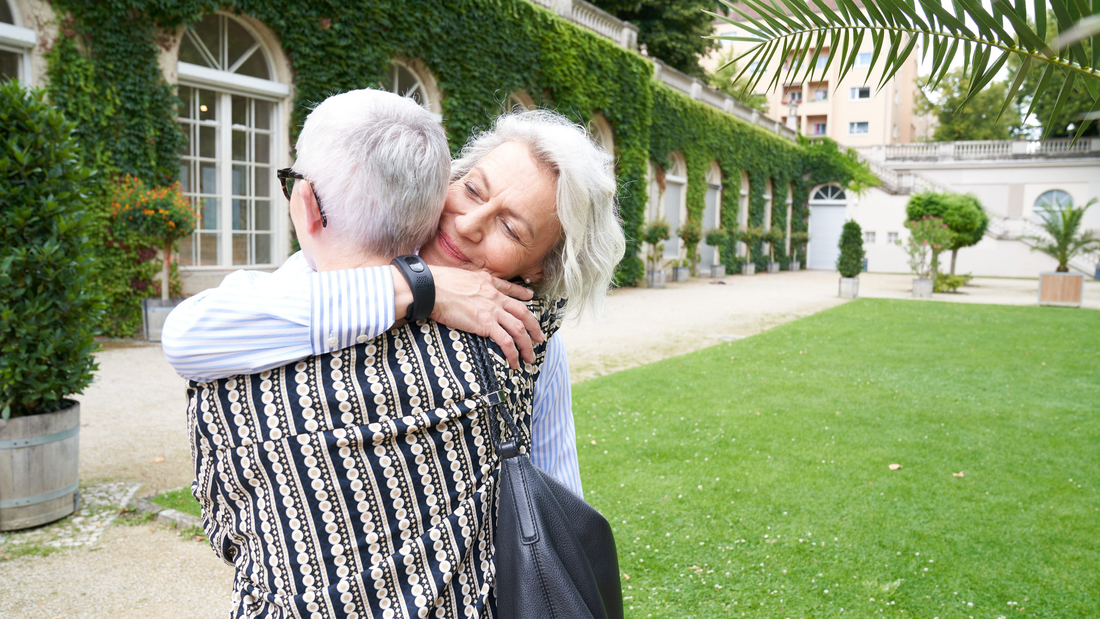
An emergency wristband is only one part of prevention. Equally important is an environment that provides orientation and reduces unnecessary risks.
Establish fixed daily routines
Recurring routines can provide security. Meals, walks, and rest periods should take place at similar times if possible.
Always keep important things in the same place
Keys, glasses, wallet, and medications should have designated places. Highly visible signs can also help.
Keep walkways clear
Loose rugs, cables, small furniture, and hard-to-see door thresholds increase the risk of falling.
Ensure good lighting
Night lights, motion detectors, and bright stair lighting make orientation easier – especially on the way to the bathroom.
Have medications reviewed
Some medications can increase fatigue, dizziness, or confusion. However, changes should never be made without consulting a doctor.
Maintain movement
Walks and adapted strength and balance exercises can help maintain mobility and safety for as long as possible.
Build a support network
Relatives, neighbors, outpatient services, and counseling centers should know how to provide support if needed.
Conclusion
Early-stage dementia does not automatically mean that an independent daily life is immediately no longer possible. Many affected individuals continue to live in their familiar surroundings, go for walks, do their shopping, and spend time alone. An emergency call bracelet for seniors can be a valuable addition during this phase. It offers an easily accessible emergency button and, with the right features, can react to a potential fall. Particularly important are intuitive operation, regular wearing, and a clearly organized emergency chain. The Gardia emergency call bracelet combines a central emergency button with FallGuard360° fall detection, mobile use, and direct voice communication. The location is provided in an active emergency; continuous monitoring is not intended. Whether the system fits the personal situation should be decided together with the affected person and regularly re-evaluated. The goal is not to restrict independence, but to have support ready where it is needed in an emergency.
FAQ: Frequently Asked Questions
Is an emergency wristband for seniors with early-stage dementia useful?
Does an emergency wristband also work without a smartphone?
Does an emergency wristband detect disorientation?
Does the Gardia emergency wristband automatically detect a fall?
Who is notified in case of an emergency call from the Gardia emergency call wristband?
What happens as dementia progresses?
My mother still lives alone and manages well in her daily life. However, for some time now, she's been forgetting where her phone is more frequently. After a small fall in the bedroom, she was very unsettled. With the Gardia emergency call bracelet, she feels safer again because in an emergency, she only has to press the button on her wrist. It's also reassuring for me to know that I'll be informed via the My Gardia app. The bracelet gives her security without her feeling constantly monitored."