Stay active – gardening as a gentle fitness program

Gardening is often underestimated. For many, it's a hobby or an everyday chore, yet it's an effective exercise program that strengthens both body and mind. Especially in older age, it's crucial to stay active without overstraining the body. Traditional sports are difficult for many or become less appealing over time. Gardening can be a natural alternative here: it combines movement with purpose, fresh air, and visible results.
Movement with Purpose, Not Just Obligation
The decisive difference to traditional training lies in the purpose.
In the garden, it's not about repetitions or performance, but about specific tasks:
- Planting seedlings
- Loosening soil
- Maintaining paths
- Harvesting
Every movement has a goal. This fundamentally changes the perception of physical activity. Many automatically stay active longer without feeling like they "have to exercise."
Which areas of the body benefit
Gardening often has a more holistic effect than one initially thinks.
Typical effects:
-
Core stability through bending and straightening
-
Leg strength through standing, walking, and bracing
-
Fine motor skills through precise hand movements
-
Coordination through alternating movement sequences
The combination is particularly valuable: the body is not trained in isolation, but challenged in natural movements.
Stay active – with a sense of security in everyday life
Whether in the garden or on the go: those who are active want to be able to move freely. The Gardia emergency wristband ensures that help arrives quickly in an emergency – discreetly in the background.

Which gardening tasks are particularly effective
Not every garden activity has the same effect on the body. While some movements are relatively easy, others can specifically promote strength, flexibility, and endurance.
Particularly effective, for example, are:
-
Loosening and digging up soil
engages arms, shoulders, and torso and strengthens core muscles
-
Carrying watering cans or soil
promotes strength and stability and supports better body control
-
Working in a slightly bent position
improves flexibility and trains the coordination between the upper and lower body
-
Walking between beds or work areas
strengthens endurance and supports a stable, safe gait
It's not the individual activity that's crucial, but the combination of different movements. Only through variety does a natural full-body workout emerge that challenges the body holistically.
Why Consistency Is More Important Than Intensity
Many people overestimate how much exercise is necessary. The duration of individual sessions is not as crucial as continuity.
Even small routines can make a big difference in the long run:
- 15–30 minutes daily
- several short sessions instead of one long one
- consistent effort instead of overexertion
Common Gardening Mistakes
Precisely because gardening seems "harmless," risks are often underestimated.
Common mistakes include:
- work sessions that are too long without a break
- unaccustomed strain at the beginning of the season
- improper posture when lifting
- uniform movements over a long period
These factors lead less to acute problems than to gradual overuse.

Why Exercise Alone Isn't Enough
Even with regular activity, not every risk can be ruled out. In the garden, additional factors come into play:
- changing surfaces
- unpredictable movements
- working outdoors
- often lack of direct accessibility
Precisely for this reason, it is worthwhile to always consider movement in connection with safety. So that activity is not restricted, but supported. A mobile emergency call system can be a helpful addition in everyday life, especially if you often work alone in the garden. The Gardia emergency call bracelet automatically detects falls or allows for quick alarming at the push of a button. Stored contacts or the professional BOSCH emergency call center are informed, so that help can be organized - even without your own intervention. This keeps movement in the foreground, while safety runs in the background.
Staying active also means: avoiding overexertion
A common misconception: more activity automatically means more health. In fact, the opposite is often true when the body is overstrained.
Warning signs can include:
- decreasing stability
- uncertainty when standing up
- rapid exhaustion
- slight balance problems
These signs should be taken seriously – they often develop insidiously.

Practical tips for more effective exercise
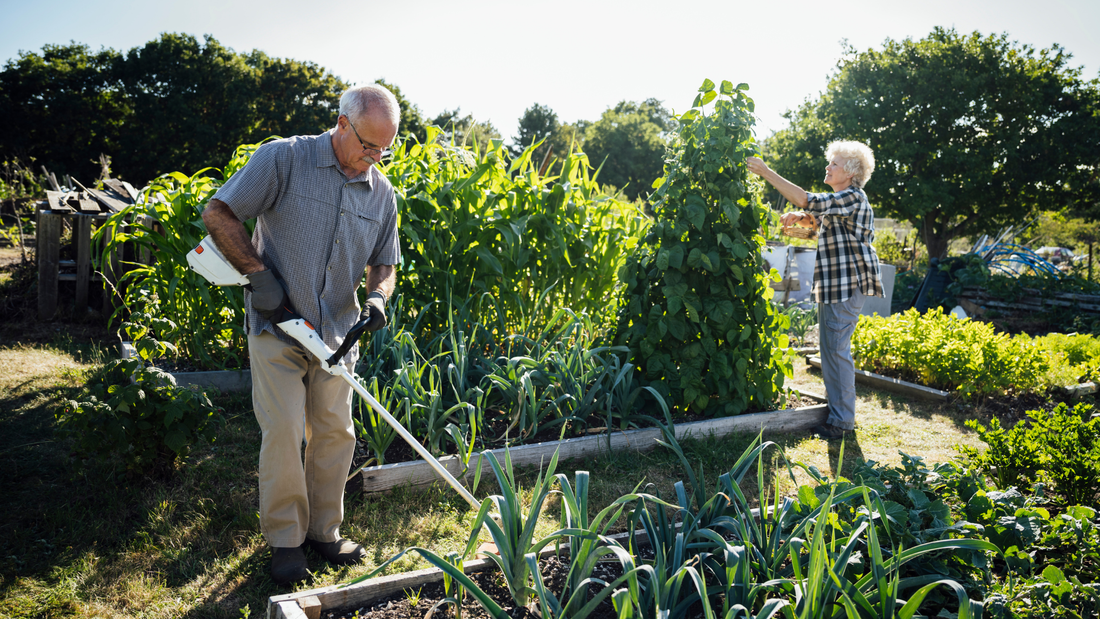
With small, targeted adjustments, gardening can be used much more effectively to keep the body active and at the same time avoid overexertion. It's not the quantity of work that matters, but the way it is performed.
1. Perform movements consciously and in a controlled manner
Avoid hasty or uncontrolled movements. Slow, even movements challenge the muscles more intensely and simultaneously improve coordination. Those who work consciously train not only strength but also body awareness and stability.
2. Change sides regularly
Many activities are automatically performed with the same hand or side of the body. Make sure to change sides regularly. This prevents one-sided strain and ensures that both halves of the body are activated equally.
3. Pay attention to an upright and stable posture
Especially during longer periods of working while standing or bending, posture is crucial. Try to keep your back as straight as possible and work from your legs. A stable posture relieves the spine and protects the joints.
4. Combine activities consciously
Intentionally alternate between different tasks. After an activity performed standing, work while sitting or moving can be beneficial. This variety engages different muscle groups and provides balanced training.
5. Use breaks actively instead of standing completely still
Short breaks are important – but they don't have to mean being completely inactive. Light walking, stretching, or consciously straightening up help keep muscles loose and promote blood circulation.
Conclusion
Gardening is an underestimated but effective fitness program. It combines exercise with everyday life, challenges the body holistically, and can be individually adapted. The key is not intensity, but regularity and a conscious approach to one's own limits. After all, it's not about achieving as much as possible, but about staying active in the long term. And that is often best achieved where movement is naturally part of everyday life.
FAQ/Frequently Asked Questions
Is gardening enough to stay fit?
It can make a big difference, especially if done regularly.
What duration makes sense?
Even 20–30 minutes a day can have positive effects.
Is gardening suitable for all ages?
Yes, if it is adapted to one's own capabilities.
How do I avoid overexertion?
By taking breaks, varying tasks, and working mindfully.
Is the Gardia emergency bracelet waterproof and suitable for outdoor use?
Yes, the Gardia emergency wristband is water and dust-proof, making it well-suited for everyday outdoor use, even in the rain or during gardening activities. It can be worn outdoors without issue and works both at home and on the go, ensuring you are protected even outside your home.
"I never exercised, but my garden was always my balance. At some point, I noticed that I had become more careful. Not because I wanted to – but because I felt insecure. Today, I go out normally again, work in the garden, and enjoy it. The only difference is: I now have the confidence that I'm not alone in an emergency."