Check your fitness to drive: Safe Driving
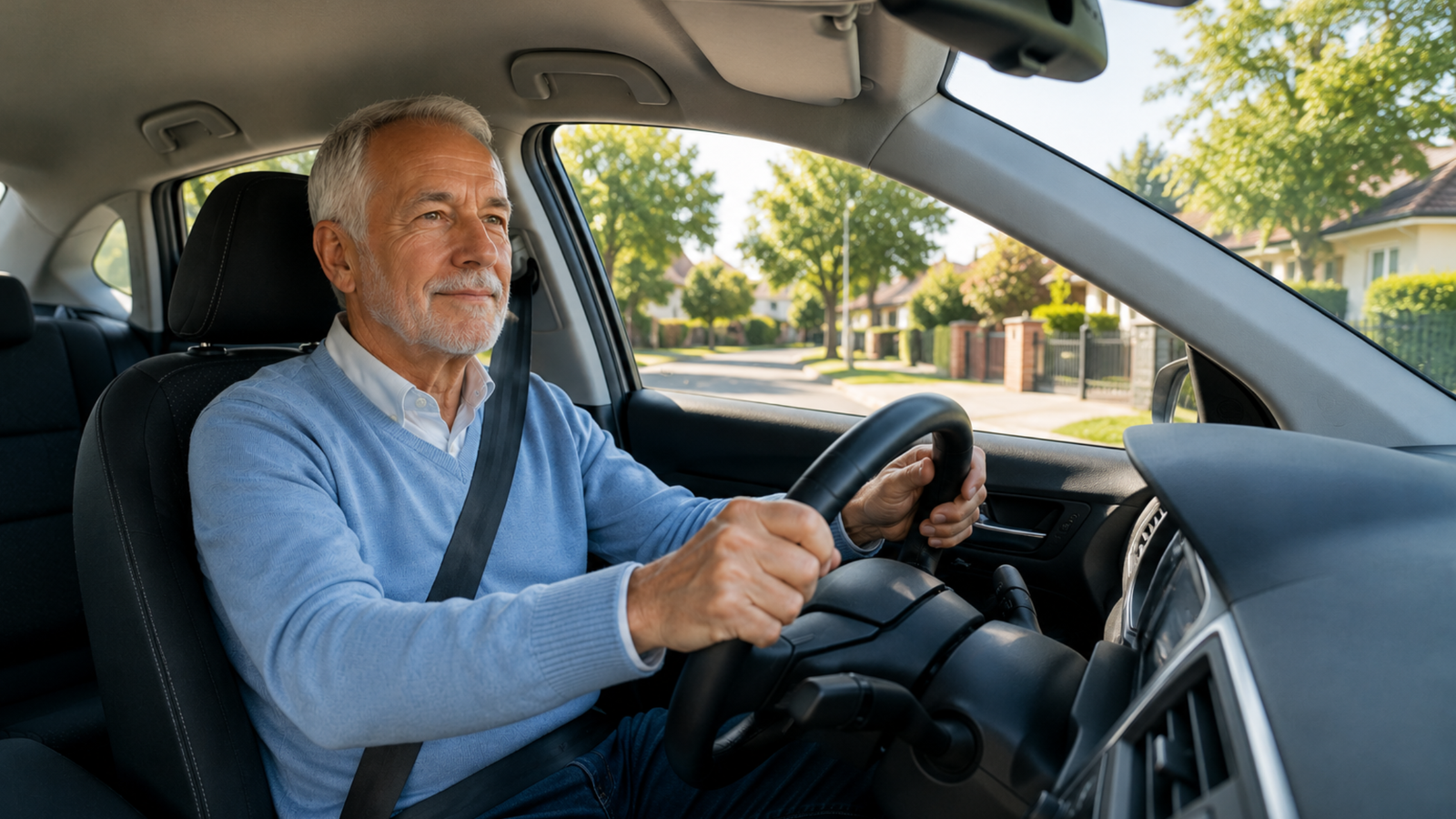
For many people, driving means much more than just getting from A to B. It means being able to do their own shopping, visit friends and family, attend doctor's appointments, or spontaneously go on an outing. For many, their own car is therefore an important part of their independence and mobility.
However, the ability to drive safely does not automatically remain the same throughout life. Eyesight can change, reactions can slow down, and illnesses or medications can also influence how safely we navigate traffic.
This by no means implies that a certain birthday determines whether someone can still drive safely. Much more important is one's individual physical and mental condition.
The crucial question is therefore not: "Am I too old to drive?" But rather: "Do I still feel safe – and can I still reliably manage traffic situations?"
This guide shows what signs may indicate that one's driving ability should be examined more closely, what role medications and health play, and how mobility can be maintained safely for as long as possible.
Mobility means independence
A driver's license enables independence. Especially where buses and trains are only partially available, owning a car can be crucial for managing daily life independently. A doctor's appointment, weekly grocery shopping, or visiting friends become significantly more complicated if one suddenly no longer has their own means of transportation. Therefore, the question of fitness to drive is emotional.
Those who notice doubts about their own driving safety may fear losing an important piece of freedom. Relatives, in turn, face the difficult question of whether and when they should address their observations.
However, the topic does not have to begin with a complete renunciation of driving. It is much more sensible to regularly and honestly assess one's own driving ability and to perceive changes early on.
Is safe driving a question of age?
No. Age alone is not a reliable indicator of whether someone can drive safely.
People age very differently. A person can be physically and mentally very fit at 80, while a much younger person may have illnesses, medications, or impairments that affect their driving ability.
Therefore, individual performance is crucial. However, as one gets older, changes relevant to driving can occur more frequently. These include, for example, declining eyesight, reduced mobility, or slower processing of complex traffic situations.
At the same time, long-term drivers have something very valuable: experience. Those who have been driving for decades can at least partially compensate for some changes through anticipatory and defensive driving. It is crucial to know one's own limits and to adapt one's driving behavior accordingly.

What skills do you need for safe driving?
Driving often seems self-evident to experienced drivers. In reality, the body constantly processes a large amount of information.
We observe other vehicles, recognize traffic signs, check mirrors, estimate speeds, and react to pedestrians or cyclists.
Particularly important are:
- Vision: Distances, traffic signs, people, and obstacles must be recognized in good time.
- Reaction time: If a vehicle suddenly brakes or someone steps onto the road, a quick reaction is necessary.
- Attention: Multiple traffic situations must be observed simultaneously.
- Mobility: Checking over your shoulder, parking, and observing traffic behind you require sufficient mobility.
- Orientation: Even on unfamiliar routes, attention should remain on traffic despite navigation.
If one of these abilities changes, it does not automatically mean that one should no longer drive. However, if difficulties accumulate, a more precise assessment is worthwhile.
You should take these signs seriously
Often there isn't a single moment when driving ability suddenly changes. Instead, small uncertainties creep into daily life.
Perhaps driving in the dark becomes more unpleasant. Merging at a busy intersection takes longer. Or one feels unusually exhausted after a longer drive.
You should pay attention, for example, if you:
- frequently overlook traffic signs or exits,
- suddenly feel insecure on familiar routes,
- notice difficulties merging or turning,
- frequently brake very late,
- perceive other road users late,
- increasingly have problems with the shoulder check,
- see significantly worse at night or in rain,
- are unusually exhausted after short drives,
- frequently experience minor near-misses,
- are repeatedly told by passengers about unsafe situations.
A single mistake can happen to anyone. What is more crucial is whether certain situations repeat themselves or uncertainties increase.
Why eyesight plays a special role
A large portion of the information processed while driving is received through the eyes.
This isn't just about being able to read small letters on an eye chart. Contrast sensitivity, visual field, spatial vision, and glare sensitivity also play a role.
Changes often become particularly noticeable in the presence of:
- Darkness,
- low-lying sun,
- rain,
- oncoming headlights,
- poorly lit roads.
Anyone who notices that such situations are becoming increasingly strenuous should have their vision checked.
A new pair of glasses or an adjusted visual aid can sometimes already make a significant difference.
Reaction time: When something suddenly happens
In road traffic, seconds can be crucial.
A child runs into the street between parked cars. A vehicle in front brakes abruptly. A cyclist suddenly appears in view when turning.
As we age, processing complex situations can become slower. This may hardly be noticeable in everyday life – but it can become relevant in road traffic.
A good strategy is to reduce situations with particularly high stress as much as possible.
For example, if you notice that heavy rush hour traffic has become more strenuous, you can consciously plan trips outside of peak times. Night driving, bad weather, or unfamiliar routes can also sometimes be avoided.
This is not a loss of independence.
On the contrary: consciously adapting your driving behavior can help to maintain mobility safely for longer.

Medication and Driving Ability: An Often Underestimated Connection
Not only physical changes can affect driving. Medications also play an important role.
Certain medications, for example, can cause drowsiness, dizziness, lightheadedness, or slowed reaction times. This can be particularly relevant after starting a new medication, changing a dosage, or combining different medications.
Therefore, it's worth checking the package insert. If in doubt, medical or pharmaceutical advice should be sought.
Special attention is advisable if, after taking medication, you suddenly experience:
- dizziness,
- severe drowsiness,
- lightheadedness,
- concentration problems, or
- visual disturbances.
However, medications should never be reduced or discontinued independently. Instead, it should be clarified whether and how the respective preparation can affect driving ability.
Illnesses can influence driving aptitude
Certain illnesses can also be relevant for safe participation in road traffic.
The German Driver's License Ordinance, for example, takes into account illnesses and impairments that can impair or, under certain circumstances, exclude driving aptitude.
This does not mean that a diagnosis automatically leads to the loss of a driver's license.
The type and extent of the illness, as well as the individual situation, are decisive.
Anyone who receives a new diagnosis or notices significant health changes should therefore discuss with their treating doctor whether there may be effects on driving.
Do you have to take a fitness-to-drive test from a certain age?
For a regular car driver's license in Germany, there is currently no general mandatory fitness-to-drive test based solely on a specific age.
However, this does not mean that one's own driving aptitude should not be checked.
Especially if initial uncertainties arise, a voluntary check can be useful.
The ADAC, for example, offers a Driving Fitness Check. The participant drives their own vehicle together with a qualified driving instructor and then receives an individual assessment.
The advantage: It's not about stopping someone from driving as quickly as possible.
Rather, specific situations can be identified where one's own driving behavior can be improved or adapted.

Self-check: Am I still safe to drive?
If you want to question your driving ability, you can first honestly answer a few questions for yourself:
- Do I generally feel safe when driving?
- Can I still quickly grasp traffic situations?
- Do I see well enough in the dark and in bad weather?
- Is it still easy for me to do a shoulder check?
- Have there recently been more situations where I was startled or reacted very late?
- Do I now avoid certain routes due to uncertainty?
- Have relatives or friends commented on my driving behavior?
A "yes" to a single question does not automatically mean that driving should be stopped. However, several changes can be a good reason to have your driving ability professionally checked.
What relatives can do
For family members, the topic is often even more difficult. Perhaps it becomes apparent that a parent frequently brushes curbs, has difficulty parking, or seems increasingly overwhelmed in heavy traffic.
A sentence like: "You shouldn't drive anymore." understandably quickly leads to resistance.
Because for the person concerned, it's not just about the car. It's about freedom, habits, and independence.
Therefore, a conversation about concrete observations is more helpful. Instead of fundamentally questioning driving ability, family members can, for example, ask: "I've noticed that driving at night seems quite strenuous for you now. How do you feel about that yourself?"
This creates a conversation about safety without fundamentally questioning the other person's independence.
Staying mobile without having to make every trip yourself
The decision doesn't have to be exclusively between "continue driving as before" and "give up your driver's license." There are many options in between.
Some people continue to drive short, familiar routes but avoid highway driving. Others only drive during the day or avoid heavy rush hour traffic.
Public transport, taxi services, ride services, neighborhood help, or shared rides with family members can also replace individual trips.
It is crucial to try out alternatives early. Those who only think about it when driving is suddenly no longer possible at all often experience the change as a significant loss.
Those who gradually integrate other forms of mobility into their daily lives, on the other hand, retain more freedom of choice.

Independent on the go – even outside the car
Mobility does not end at the car door. Walks, shopping, doctor's appointments or meeting friends are also part of a self-determined daily life.
Especially when the car is used less and less, other means of transport become more important. At the same time, many people and their relatives also want an additional sense of security when they are out and about.
Mobile emergency call systems can be a useful addition here.
The Gardia emergency call wristband accompanies its users not only at home, but also when they are out and about. In an emergency, a call can be triggered directly from the wrist. The intelligent FallGuard360° fall detection can also detect a possible fall and automatically start the emergency process.
The smartphone does not have to be taken out of a bag at the crucial moment. Modern technology can thus help to not restrict mobility, but to make it self-determined for as long as possible.
More than just an emergency bracelet

Security does not mean giving up freedom
Questioning one's own fitness to drive can be unpleasant. Nevertheless, it is a sign of responsible mobility.
It is not the date of birth that determines whether someone can still drive safely. What is crucial are personal abilities, health status, and the willingness to perceive changes.
Sometimes new glasses are enough. Sometimes it helps to avoid driving at night or to plan journeys differently. And sometimes the time comes when other means of transport become safer.
The goal should always remain the same: As much independence as possible – with as much safety as necessary.
At what age should one have their driving ability checked?
Is there a mandatory driving fitness test for older drivers in Germany?
What signs can indicate a decline in fitness to drive?
Can medication impair driving ability?
How can I voluntarily check my driving fitness?
What can I do if I want to drive less?
Conclusion: Staying safely mobile starts with an honest self-assessment
Driving provides freedom and is an important part of an independent life for many people. Therefore, the decision about one's own fitness to drive should not be based solely on age.
More important is the question of how safe one actually is on the road. Those who notice changes in vision, reaction, or concentration early, clarify health issues, and adapt their driving behavior if necessary can often remain safely mobile for a long time.
And if the car is eventually parked more often, that does not automatically mean less independence. It is crucial to create other options in good time to ensure that daily life can continue to be active and safe.