Battery Life of Emergency Watches: How long does the battery really last?

An emergency watch should be quickly accessible in an emergency. For this, it must function reliably, be sufficiently charged, and actually be worn on the wrist. This is precisely where different emergency call systems vary in everyday use. Many emergency watches combine mobile communication, GPS, a display, and additional functions in one compact device. This equipment requires energy and can mean that the watch needs to be recharged regularly. While charging, it lies on the charging station and is not on the wrist. If it is not put back on immediately afterward, it can be missing at the crucial moment. In this article, you will learn what influences the energy consumption of an emergency watch, how long the battery lasts in everyday use, and why a longer battery life can be important for seniors and their relatives.
Key facts at a glance
- Mobile communication, GPS, displays, and additional functions influence the battery consumption of an emergency watch.
- The actual battery life depends on the model, usage, and environmental conditions.
- Frequent charging leads to regular interruptions in wear.
- An emergency call system can only help if it is charged and on the wrist.
- An emergency bracelet, for example, offers a battery life of up to 21 days, while an emergency watch needs to be charged daily.
Why is battery life so important for an emergency watch?
In an emergency, an emergency call watch should be immediately accessible. This only works if it is sufficiently charged and worn by the person concerned. A short battery life does not automatically make an emergency call watch unsafe. However, it requires a reliable charging routine. The device must be regularly removed, charged, and then put back on. In everyday life, this can lead to situations where the emergency call system is not available:
- The watch charges overnight while the person goes to the toilet.
- The device remains on the charging station after charging.
- The battery level is not checked before a longer outing.
- The correct charging cable is missing when traveling.
- The daily charging routine is forgotten.
- Relatives have to regularly remind them to charge it.
For people who are confident with technical devices and reliably maintain fixed routines, regular charging can work well. It becomes more difficult if charging is forgotten more often or if the person needs support with recurring processes.
Why do many emergency call watches consume comparatively a lot of energy?
Battery life does not depend solely on battery size. Equally important are the functions the device offers and how frequently they are used.
Mobile Connectivity
Many mobile emergency watches have an integrated SIM card or eSIM. This allows them to connect to the mobile network independently of a smartphone. To ensure the device remains reachable, it must maintain regular contact with the network. In areas with good reception, less energy is usually required for this. In areas with weak mobile reception, power consumption can increase because the device searches more intensively for a stable connection.
GPS and Location Tracking
In an emergency, GPS can help determine the location of the person wearing the device. This is particularly important if they cannot precisely describe where they are. However, location tracking requires energy. The more frequently a device determines and transmits its position, the more this can drain the battery. There are significant differences between systems. Some devices determine their location regularly in the background. Others transmit it specifically during an active emergency.
Display and Touchscreen
The display is one of the biggest power consumers in many mobile devices. Particularly color displays, high brightness, and touchscreens require power. If the display is frequently activated, for example, to read the time, operate menus, or check messages, the battery life can be further shortened. An emergency wristband without a touchscreen does not require energy for such displays. This can result in lower power consumption.
Sensors and Additional Functions
Many emergency watches offer additional functions besides the emergency call, such as:
- Pedometer,
- Heart rate measurement,
- Activity detection,
- Sleep analysis,
- Reminders,
- Messages,
- Weather displays,
- Background synchronization with an app.
How long does the battery of an emergency watch last?
There is no general answer, as the battery life varies depending on the model and usage. However, many emergency watches with mobile connectivity, GPS, display, and additional functions achieve approximately 24 hours of battery life in everyday use and therefore usually need to be charged daily. Longer battery life is possible under favorable conditions.
Key factors include:
- the quality of mobile reception,
- the frequency of location tracking,
- display usage,
- active sensors and background functions,
- voice connections,
- the ambient temperature,
- the age of the battery.
Manufacturer specifications usually refer to specific usage conditions. The actual battery life may therefore differ in everyday use. In comparison, the Gardia emergency wristband offers a battery life of up to 21 days and needs to be charged much less frequently.
Why can frequent charging become a problem?
Charging itself is necessary and generally unproblematic. It only becomes critical if the emergency call system is not worn during charging or is not put back on afterwards. Situations in which falls or other emergencies can occur unexpectedly are particularly relevant:
- at night on the way to the toilet,
- when getting out of bed,
- in the bathroom,
- when getting dressed,
- on stairs,
- when going into the garden,
- shortly after getting up in the morning.
If the emergency call watch is on the charging station at this moment, it cannot be reached via the emergency call button. An automatic fall detection can also only work if the device is worn. A long battery life does not completely prevent such situations. However, it reduces the number of charging cycles and thus also the time during which the device is not on the wrist.
Gardia and Emergency Watch in Battery Comparison
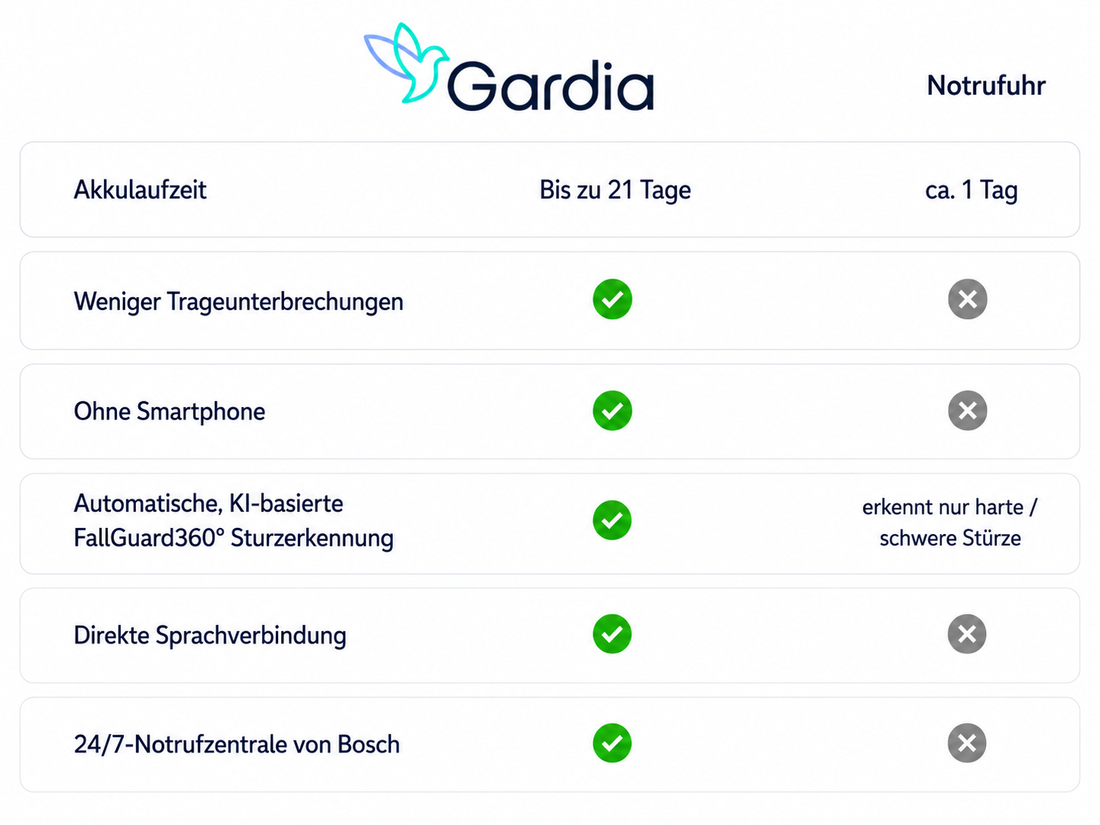
The decisive difference lies in everyday use: While many emergency watches offer additional functions such as a display, apps, or fitness features, Gardia focuses on the functions relevant for emergency protection. This allows for lower energy consumption, and the wristband needs to be charged significantly less often.
Why the Gardia emergency wristband offers up to 21 days of battery life
The Gardia emergency wristband was deliberately developed for the movement patterns of seniors and people with an increased risk of falling. It focuses on the functions that are crucial in an emergency:
- Emergency call at the touch of a button,
- automatic, AI-based FallGuard360° fall detection,
- direct voice connection,
- location transmission in an active emergency,
- notification of up to six private emergency contacts,
- optionally, Bosch's professional 24/7 emergency call center.
The emergency wristband has no touchscreen, no fitness apps, and no constantly changing displays. This means less energy is needed for the display, background applications, and additional operating functions. With a battery life of up to 21 days, the Gardia emergency wristband needs to be charged significantly less often than many emergency watches with extensive additional functions. This results in fewer interruptions to wear. Operation also remains clear. The wearer does not need a smartphone and does not have to operate an app, menus, or complicated settings. The Gardia emergency wristband works at home and on the go thanks to the integrated mobile phone connection.
This is how an emergency call system remains reliably operational
Even with a long battery life, charging should be a fixed part of your daily routine.
Regularly check battery level
Check the battery level in good time and do not wait until the device is completely discharged.
Choose a fixed charging time
A recurring charging time makes the routine easier. If possible, choose a period when the wearer is not alone or is moving very little.
Place charging station in a visible spot
The charging station should be easily accessible and clearly visible. A fixed location helps to quickly put the device back on after charging.
Put it back on immediately after charging
The emergency call system should not remain on the charging station longer than necessary. Put it back on as soon as possible after it is fully charged.
Check before outings and trips
Check the battery level before longer activities. Take the appropriate charging accessories with you for multi-day trips.
Avoid extreme temperatures
Do not leave the device in direct sunlight, in a hot car or in extreme cold for long periods.
Fewer charges, longer protection

What should one look for when buying an emergency watch?
Battery life is important, but it should not be considered in isolation. A good emergency call system must fit the everyday life of the wearer as a complete solution. Pay particular attention to:
- the maximum and realistic battery life,
- easily recognizable warnings for low battery levels,
- simple charging options,
- an easily accessible emergency button,
- automatic fall detection,
- independent use without a smartphone,
- voice communication via the device,
- mobile usability outside the home,
- private emergency contacts and optionally an emergency call center,
- water and dust protection,
- easy-to-understand operation.
A long battery life only offers real added value if the emergency call functions are also easy and reliable to use.

Who is the Gardia emergency bracelet particularly suitable for?
The Gardia emergency wristband can be particularly suitable if you or your relative:
- want a simple emergency solution,
- do not want to operate a touchscreen,
- do not want to carry a smartphone,
- find long battery life important,
- want to wear the device at night as well,
- often forget to charge it,
- want to remain reachable at home and on the go,
- want automatic fall detection,
- want to integrate private contacts or a professional emergency call center.
It is crucial that the future wearer is involved in the selection process. An emergency call system can only help if it is accepted, charged, and actually worn.

Checklist: What to look for when buying a battery
✔ How long does the battery last under realistic conditions?
✔ Which functions are active during this runtime?
✔ How often does the device need to be charged?
✔ Will the person be able to charge it independently?
✔ Is there a clearly visible battery level indicator or reminder?
✔ How long does a full charging process take?
✔ Can the device be worn while charging?
✔ Is the appropriate charging accessory easy to use?
✔ Does the device work without a smartphone?
✔ How much do GPS and mobile connectivity affect the battery life?
✔ Does the charging routine fit into the wearer's daily life?
Conclusion
An emergency watch can only help if it's charged and worn on the wrist. The more frequently a device needs charging, the more often there will be times when it's not being worn. The Gardia emergency wristband offers up to 21 days of battery life, reducing the number of necessary charging cycles. At the same time, it focuses on the core functions of an emergency call system: emergency call at the touch of a button, AI-based FallGuard360° fall detection, direct voice connection, integrated cellular connection, and location transmission in an active emergency. For seniors, this means less charging effort and simpler everyday use. Family members also have to remind them less frequently to charge it.
FAQ: Frequently Asked Questions
How long does the battery of an emergency call watch last?
What drains the battery most on an emergency watch?
Does the Gardia emergency call wristband need to be charged daily?
Why is a long battery life important for seniors?
Is an emergency watch with short battery life unsafe?
Does Gardia work without a smartphone?
"My mother's old emergency watch had to be charged almost every evening. Often, it would still be on the charging station in the morning because no one remembered to put it back on her. Especially at night or when she went to the bathroom, this made us uneasy. Since she's been wearing Gardia, that's changed. The long battery life means the wristband stays on her wrist much more often – and we don't have to constantly remind her to charge it. This gives my mother more security and us as a family significantly more peace of mind."